
Architecture
هذا المحتوى غير متوفر بلغتك بعد.
This document describes how MirbadLLM is built and the behaviour each part promises.
MirbadLLM runs local LLMs on one or more machines and serves all of them behind one OpenAI-compatible /v1
endpoint. A master holds the model registry, API keys, the Blazor UI, the admin API and the router. A node
agent on every machine starts and stops the models with that machine’s runtime (vLLM in containers, llama.cpp as a
native process, MLX on Apple Silicon), checks memory before a start, and reports telemetry.
Architecture
Section titled “Architecture”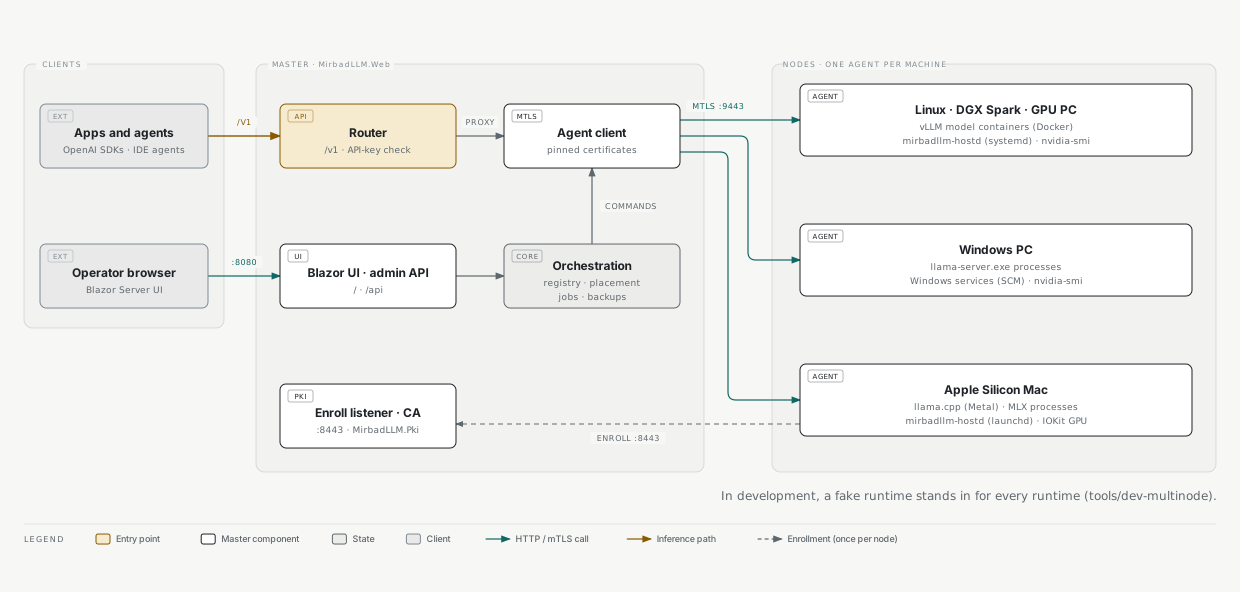
The master never touches Docker, a GPU or a model file. Every host-specific action goes through the node’s agent over
mutual TLS (https://<agent>:9443/agent/v1). A request to /v1 flows like this:
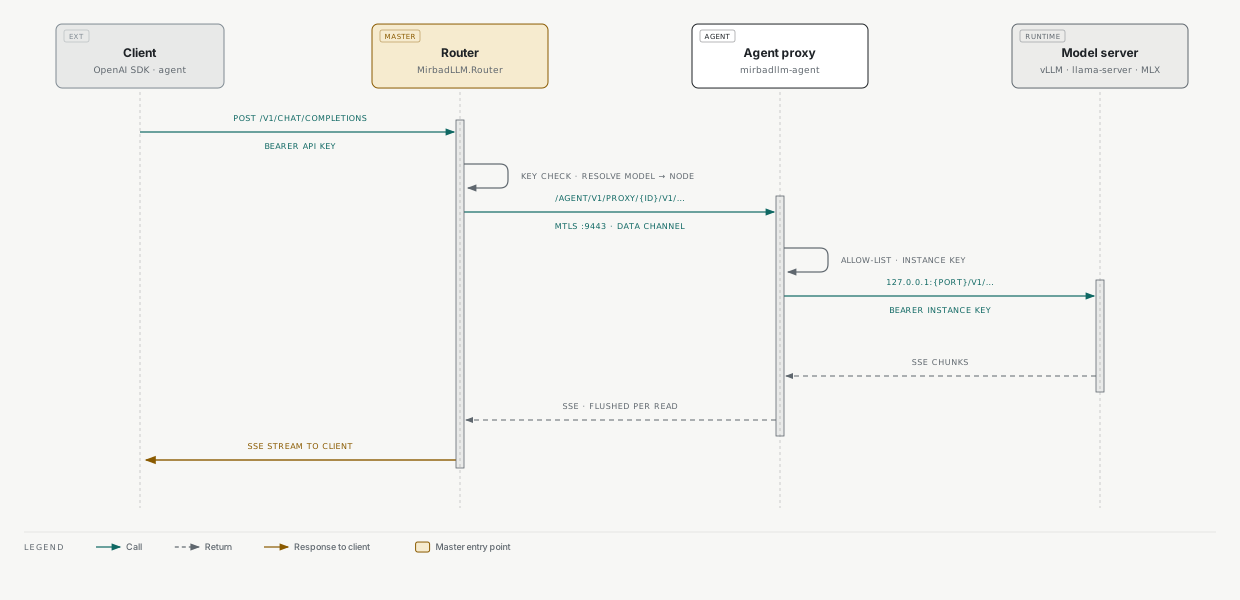
- The router checks the bearer key (when keys are required) and resolves the
modelfield against the registry. - The master proxies the request to the model’s node agent,
https://<agent>:9443/agent/v1/proxy/{modelId}/v1/.... - The agent forwards it to the runtime on a loopback or container-network port, adding the per-instance key where the runtime has one.
- Responses, including server-sent event streams, come back the same way. Bodies up to 64 MiB are accepted, chunked
or not; larger ones get 413
request_too_large. Other endpoints keep Kestrel’s default limit (30,000,000 bytes).
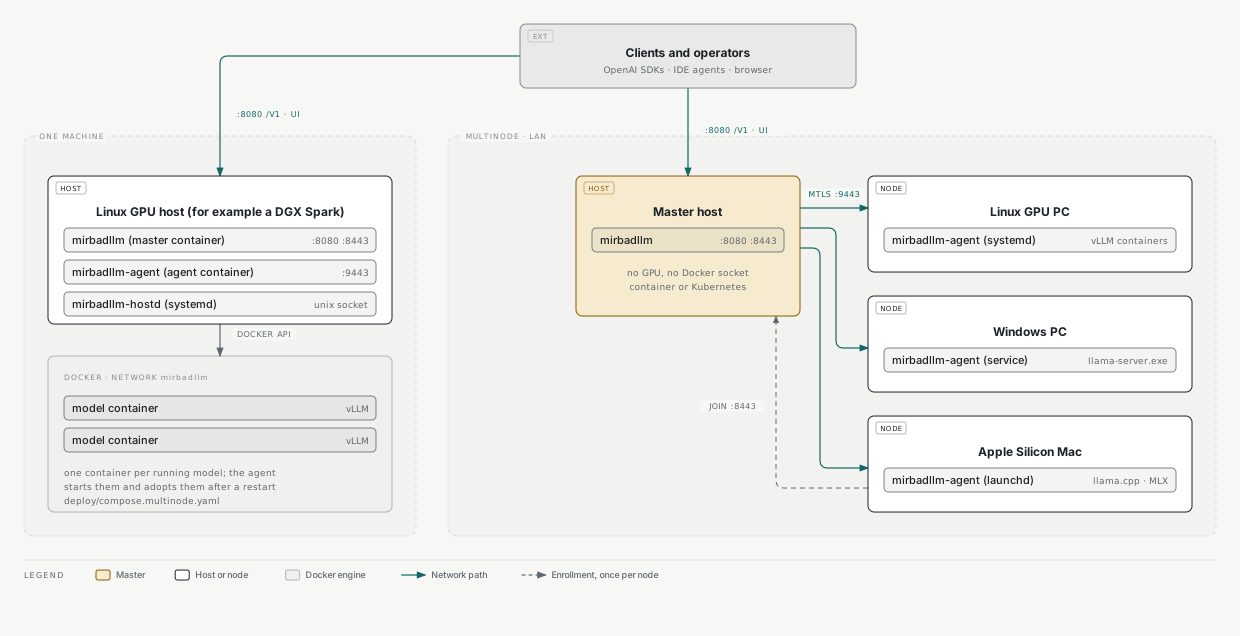
deploy/compose.multinode.yaml runs the master and the machine’s own agent as two containers, so one machine is a
fleet of one. Other machines join as nodes with the Linux, Windows or macOS agent installers.
Master and node agents
Section titled “Master and node agents”The master (MirbadLLM.Web composition, container mirbadllm) keeps the registry, API keys, UI, admin API,
router, backups, jobs, PKI and fencing. It has no Docker socket, no model folders, no hostd socket and no GPU. It
reaches every node through that node’s agent over mTLS (HTTP/2, https://<agent>:9443/agent/v1, operator guide
docs/multinode/operations.md):
RemoteModelRuntimestarts, stops and restarts models;RemoteTelemetryCollectorand the remote probes read memory, GPU and model metrics.AgentEndpointResolver(inMirbadLLM.Router) resolves a served name to its node from the registry placement and the node status cache.RemoteHostUnitBackend,RemoteHostContainerBackendandRemoteBackupMountClientserve the Services page and the backup destination.
The node agent (MirbadLLM.Agent, mirbadllm-agent) creates, adopts and stops the models, runs admission (a
memory reserve; one start at a time on unified memory; per-GPU budgets on discrete GPUs), downloads, folder listing,
GGUF header reads, host services, telemetry (memory, nvidia-smi, each model’s /metrics) and a reverse proxy to the
models. It runs as a container on the DGX Spark, a systemd service on a Linux PC, a Windows service (virtual account
NT SERVICE\mirbadllm-agent, logging to the Event Log) on Windows and the LaunchDaemon com.mirbadllm.agent on a Mac.
Runtimes. Two drivers implement IRuntimeDriver in MirbadLLM.NodeRuntime:
- The container driver (
ContainerRuntimeDriver) runs vLLM models as Docker containers on Linux nodes; its contracts are under Orchestration. - The process driver (
ProcessRuntimeDriver,Delivery = Process) runs llama.cpp’sllama-serverand MLX as native processes on Windows and macOS. It owns the state machine,processes.json, port use, health, logs, crash handling and adoption, and calls no OS API itself: that work sits behindIProcessHost, implemented byWindowsProcessHost(CreateProcessWplus a per-instance job object without kill-on-close, so a model outlives an agent restart, upgrade or crash and is adopted by PID, creation time and image path) andMacProcessHost.ExecutableCatalogmaps a logical name and version to a verified path,IGgufReaderreads GGUF headers andIInstanceKeyProtectorprotects each instance’s API key at rest. On the master,LlamaCppArgsBuilderandLlamaCppArgsParserbuild and read the argv,LlamaCppMemoryEstimategives the admission estimate and the router emulatesdimensionsfor llama.cpp embedding models. Restart-pending for a process model compares execution fingerprints.
Composition. One setting, Agent:Docker:Enabled, decides what an agent composes:
- Docker on (the DGX Spark and Linux PCs): the container driver, with host services through Docker and
mirbadllm-hostd. - Docker off (Windows and macOS): the process driver, but only when an
IProcessHostand anIInstanceKeyProtectorare available. Windows and macOS register both; tests and the dev setup inject them, so the Linux CI leg exercises the same code.Agent:CacheRootis mandatory, and duplicateAgent:Executablesnames are refused. A Docker-off node that has neither service still starts: it logs one warning, reports an empty runtime list and refuses every launch with 422spec_rejected. - On Windows,
WindowsServiceLifetimereports RUNNING as soon as the host starts, so only the code beforeapp.RunAsynccounts against the Service Control Manager’s 30 s. Long start work (the catalogue’s first hashing, Ready probes of adopted processes, the TLS key sweep) runs in aBackgroundService, never in a blockingStartAsync, which would keep 9443 closed.
Host services are per platform: mirbadllm-hostd under systemd on Linux, the Service Control Manager on Windows
and mirbadllm-hostd under launchd on a Mac (Services page and host agents).
Protocol. MirbadLLM.Agent.Contracts holds the one master ↔ agent protocol. An agent reports what it supports as
feature flags (for example runtime.llamacpp.process, gguf.inspect, admission.gpu-budgets, downloads.hf-native,
downloads.ollama, services.scm); new wire fields are additive and omitted at their defaults.
Fleet operations. Placement (by GPU UUID on discrete GPUs), moves and unplace (MoveService, ownership.json),
one job per node with node-scoped maintenance, takeover with continuation, restore modes, fleet recovery in recovery
mode, the audit log ({DataPath}/audit) and CA rotation. Operator guides: docs/multinode/operations-p2.md (Linux
nodes and placement) and docs/multinode/operations-p3p4.md (Windows and Mac nodes).
Projects and ownership
Section titled “Projects and ownership”| Project | Owns | Depends on |
|---|---|---|
src/MirbadLLM.Core |
Contracts only: ModelDefinition, ModelStatus, ModelEndpoint, MemorySnapshot, ModelMetrics, RouterModelStats, the interfaces in Abstractions.cs, MirbadLLMOptions. Shared by every project, so changes here are reviewed with extra care. |
— |
src/MirbadLLM.Orchestration |
Master side: vLLM and llama.cpp argument builders, JSON registry, health monitor, metrics history, jobs, backups, the node registry and monitor, agent client, RemoteModelRuntime, RemoteTelemetryCollector, remote probes/storage/host services, certificate rotation, fencing, AddMirbadLLMOrchestration. |
Core, Agent.Contracts, Pki, NodeRuntime |
src/MirbadLLM.Router |
/v1/* proxy through the agents (AgentEndpointResolver), /v1/models, API-key check, IRouterStats, AddMirbadLLMRouter / MapMirbadLLMRouter. |
Core, Agent.Contracts |
src/MirbadLLM.Web |
Program.cs composition (the master), /api/* admin endpoints, Blazor pages, the enroll listener. |
all |
src/MirbadLLM.Agent |
The node agent mirbadllm-agent. |
Core, Agent.Contracts, NodeRuntime, Pki |
src/MirbadLLM.Agent.Contracts |
Master ↔ agent protocol: routes, envelopes, events, error codes, feature flags. | Core |
src/MirbadLLM.NodeRuntime |
Node-local code the agent uses: Docker Engine client, container driver, the process driver and its IProcessHost implementations (Windows, macOS), the executable catalogue, the GGUF reader, the process record store, the instance-key protector, the Hugging Face downloader, memory and nvidia-smi probes, the hostd client. |
Core, Agent.Contracts |
src/MirbadLLM.Pki |
CA, certificate issuing from CSRs, SPKI pins, TLS validators. | Agent.Contracts |
src/MirbadLLM.HostAgent |
mirbadllm-hostd, the root daemon behind the Services page on Linux and macOS: unit discovery and control, GPU processes, the backup mount. |
— |
tests/MirbadLLM.UnitTests |
One folder per area: Orchestration/, Router/, Web/, Agent/, Multinode/. |
all |
tests/MirbadLLM.FakeLlamaServer |
A stand-in llama-server for process-driver tests. |
— |
deploy/ |
Dockerfiles, compose.multinode.yaml, the agent installers (agent/), hostd/, k8s/. |
— |
tools/ |
dev-multinode (a master and two fake-runtime agents on one machine), perf-multinode (perf harness). |
— |
Conventions (all workstreams)
Section titled “Conventions (all workstreams)”- .NET 10,
TreatWarningsAsErrors, nullable on,latest-recommendedanalyzers: 0 warnings, 0 errors. - Central package management (
Directory.Packages.props), exact versions. Do not add packages without discussing it in an issue first; everything here is doable with the BCL + ASP.NET Core. - No
Docker.DotNet: talk to the Docker Engine API (/v1.47/...) withHttpClientover the Unix socket (SocketsHttpHandler.ConnectCallback+UnixDomainSocketEndPoint), named pipe, or TCP. - Async all the way,
CancellationTokenon every I/O call,System.Text.Jsonwith web defaults. - Tests: xUnit v3 (
xunit.v3),Assert.*, no mocking library — hand-written fakes. Run withdotnet artifacts/bin/MirbadLLM.UnitTests/debug/MirbadLLM.UnitTests.dll(in-process runner), filter with-class/-namespace. The default run includes the multi-nodeChaoscategory (deterministic seeds, about 35 s in parallel); the fullPerfharness is opt-in (MIRBADLLM_PERF=1).
Behaviour contracts
Section titled “Behaviour contracts”Orchestration
Section titled “Orchestration”The container, memory, metrics and endpoint contracts in this section run on the node agent of a Docker node
(MirbadLLM.NodeRuntime / MirbadLLM.Agent); the master reaches them through RemoteModelRuntime,
RemoteTelemetryCollector and AgentEndpointResolver (see Master and node agents).
- Container naming/labels: container
ss-{Id}; labelsmirbadllm.model={Id},mirbadllm.served-name={ServedName},mirbadllm.port={hostPort}. State is always derived from Docker (list containers with label filter), never cached as truth — the agent can restart at any time and must adopt running containers. - State mapping: no container →
Stopped; running andGET http://upstream/health= 200 →Ready; running, not healthy yet →Starting; exited/dead →Failed(with the last 20 log lines inError);Stoppingwhile a stop is in flight./healthcannot see a wedged engine, so the master also flags a Ready model as Stalled or Slow from its metrics history (ModelProgress, seedocs/multinode/operations.md§9), and the agent proxy ends requests a model stays silent on forProxyUpstreamIdleTimeout. - Start: refuse (throw
ModelMemoryAdmissionException, Core) whenMemoryBudgetGiB > AvailableGiB - MemoryReserveGiBunlessforce. Pick the lowest free host port ≥PortRangeStartnot used by another mirbadllm container. Ensure the Docker network exists. Create with: image,--gpus allequivalent (DeviceRequests: [{Driver:"nvidia",Count:-1,Capabilities:[["gpu"]]}]),IpcMode: host, binds{ModelsHostPath}:/models:roand{CacheHostPath}:/root/.cache, port8000/tcp→127.0.0.1:{hostPort}, network{DockerNetwork}with aliasss-{Id},RestartPolicy: no, command = vLLM args below. Missing image → pull first. Docker never starts a model on its own: after a reboot onlyAutoStartmodels come back, through the master’s one-at-a-time boot auto-start, so models never start all at once and run each other out of KV-cache memory. - vLLM args (entrypoint is
vllm serve), in this order:--model /models/{ModelPath} --served-model-name {ServedName} [--quantization {Quantization}] --kv-cache-dtype {KvCacheDtype} --max-model-len {MaxModelLen} --max-num-seqs {MaxNumSeqs} --gpu-memory-utilization {MemoryBudgetGiB / TotalGiB, 4 decimals, invariant culture} [--enable-auto-tool-choice --tool-call-parser {ToolCallParser}] [--reasoning-parser {ReasoningParser}] [--enable-prefix-caching | --no-enable-prefix-caching] [--speculative-config {Speculative as the vLLM object, keys sorted}] [--compilation-config {"cudagraph_mode":"…", …CompilationConfig keys}] [--async-scheduling | --no-async-scheduling] [--mamba-cache-mode {MambaCacheMode}] --disable-access-log-for-endpoints /health,/metrics {ExtraArgs…}(golden command lines inVllmArgsBuilderTests.) - Canonical effective configuration (
VllmArgsNormalizer): the settings mirbadllm owns — speculative config, compilation config, max num seqs, max batched tokens, KV cache dtype, prefix caching, async scheduling, mamba cache mode — live only in typedModelDefinitionfields and are emitted exactly once. Any of them found inExtraArgs(--flag value,--flag=value, one-line--flag value,_spellings,-cc, dotted--speculative-config.num_speculative_tokens=3/--speculative_config.model X/-cc.cudagraph_mode=…,--x/--no-x) is lifted into its field with vLLM’s semantics: ExtraArgs come last, so a scalar replaces the typed value, a full JSON object replaces the whole object (vLLM keeps the last--speculative-config, verified in the image); when any dotted key of a config is present vLLM builds it from the dotted keys alone (last wins per key) and discards every full JSON object for it, typed one included, in any order (verified); every JSON key is kept.-O…is not owned. Applied on registry load (migration, persisted on the next save), on every save/API upsert (an unreadable owned flag → 400), by the builder, by the parser (a container’sCmdreads back as what vLLM ran) and by tuning apply.Speculative(SpeculativeDecoding): typedmethod(empty = inferred from the draft),num_speculative_tokens,model(draft path) plusExtra(every other key). Serialized as the vLLM object; a{"Method","NumSpeculativeTokens"}object also reads.CudaGraphModestays the typed owner ofcudagraph_mode;CompilationConfigholds every other--compilation-configkey (nevercudagraph_mode); the builder merges both into one argument.EnablePrefixCachingandAsyncSchedulingare tri-state (null= vLLM default, nothing emitted). A storedfalsemeans an explicit--no-enable-prefix-caching.
- Stop:
POST /containers/{id}/stop?t=30thenDELETE /containers/{id}. - Registry:
{DataPath}/models.json, atomic write (temp file + move),SemaphoreSlimguarded. ValidateId(^[a-z0-9][a-z0-9-]{0,39}$) andServedNameuniqueness; throwArgumentException. Seed on first run with one example definition,ornith-9b-fp8, stopped. - Memory probe: parse
/proc/meminfoMemTotal/MemAvailable(kB → GiB). On non-Linux dev boxes return a configurable fake (MirbadLLM:DevMemoryTotalGiB, default 121). - Metrics reader: scrape
GET upstream/metrics(Prometheus text). Usevllm:num_requests_running,vllm:num_requests_waiting,vllm:kv_cache_usage_perc(fallbackvllm:gpu_cache_usage_perc), and rates from countersvllm:generation_tokens_total,vllm:prompt_tokens_total(difference between consecutive scrapes / elapsed seconds). The agent scrapes each Ready model into its telemetry ring and the master’sRemoteTelemetryCollectorcomputes the rates. - Endpoint resolver:
BaseUri=http://ss-{Id}:8000/whenUseContainerNetwork, elsehttp://{UpstreamHost}:{hostPort}/. Resolves byServedName(case-insensitive). This upstream rule is the agent’s (its proxy reaches the model this way); the master resolves served names withAgentEndpointResolver(registry placement + node status cache) and proxies through the agent. - Health monitor (
BackgroundService): everyHealthPollIntervalrefresh states; on boot start models withAutoStart; log state transitions. After a node agent reboot the node’s previous running set (ModelRecoveryState,{DataPath}/running-models.json) is relaunched one at a time through the per-node start lane. Crash auto-restart (MirbadLLM:CrashRestart, default on): a model the recovery state still lists (started and never explicitly stopped) that goes Ready/Starting → Failed, or Ready → Stopped without an acknowledged Stop, is restarted through the same lane after a 10 s / 30 s / 60 s backoff, audited assystem:autostart; models under a maintenance window, a tuning run or a job’s ownership record are skipped. AfterMirbadLLM:CrashRestartLimit(default 3) crashes in a row the monitor stops retrying: the model stays Failed, the pause (model, node, crashes, last error, time) is written to{DataPath}/restart-pauses.jsonso it survives a master restart, the Models page and the model’s Overview read “Crashed 3 times, automatic restarts paused”, and the Dashboard attention list (the status-bar badge counts it) says “Automatic restarts paused forafter crashes: ”. A Start by hand (UI or POST /api/models/{id}/start) or 10 minutes of Ready clears the counter and the pause.
Router
Section titled “Router”GET /v1/models→ OpenAI list shape ({"object":"list","data":[{"id","object":"model","created","owned_by":"mirbadllm"}]}) containing Ready models byServedName.- Any other
/v1/{**path}(POST/GET): buffer the JSON body (limit 64 MiB), readmodel. Unknown → 404 OpenAI error shape{"error":{"message","type":"invalid_request_error","code":"model_not_found"}}. Known but not Ready → 503 withRetry-After: 30and a message naming the state, unlessAutoStartOnRequest: then start it and wait (poll) up toStartupTimeout. - Proxy to
{BaseUri}v1/{path}{query}withHttpCompletionOption.ResponseHeadersRead; copy status, headers (minus hop-by-hop), stream the body with flush per chunk (SSE must not be buffered — disable response buffering). Client abort cancels the upstream request (vLLM then aborts it). No upstream timeout (long generations); connect timeout 10 s. ApiKeyset → requireAuthorization: Bearer {key}on/v1/*, else 401 in OpenAI error shape.IRouterStats: total, failed (non-2xx or exception), in-flight per served name; thread-safe.
Web (admin API + UI)
Section titled “Web (admin API + UI)”Program.cs: bindMirbadLLMOptions,AddMirbadLLMOrchestration,AddMirbadLLMRouter, Razor components (interactive server), map/api/*,MapMirbadLLMRouter,/healthz.- Admin API:
GET/POST /api/models,GET/PUT/DELETE /api/models/{id},POST /api/models/{id}/start?force=,POST /api/models/{id}/stop,GET /api/models/{id}/logs?tail=(text/event-stream),GET /api/status(memory + all statuses + metrics + router stats). 409 on memory refusal, 404 unknown id. Node problems answer 409/503/504 (docs/multinode/operations.mdsection 7). - UI pages (Blazor, interactive server): Overview, Models (the model editor, logs, benchmarks and tuning),
Playground, Access (API keys and connection snippets), Nodes, Services, Backup & restore and
Releases. Light and dark themes via
data-bs-theme.
Services page and host agents
Section titled “Services page and host agents”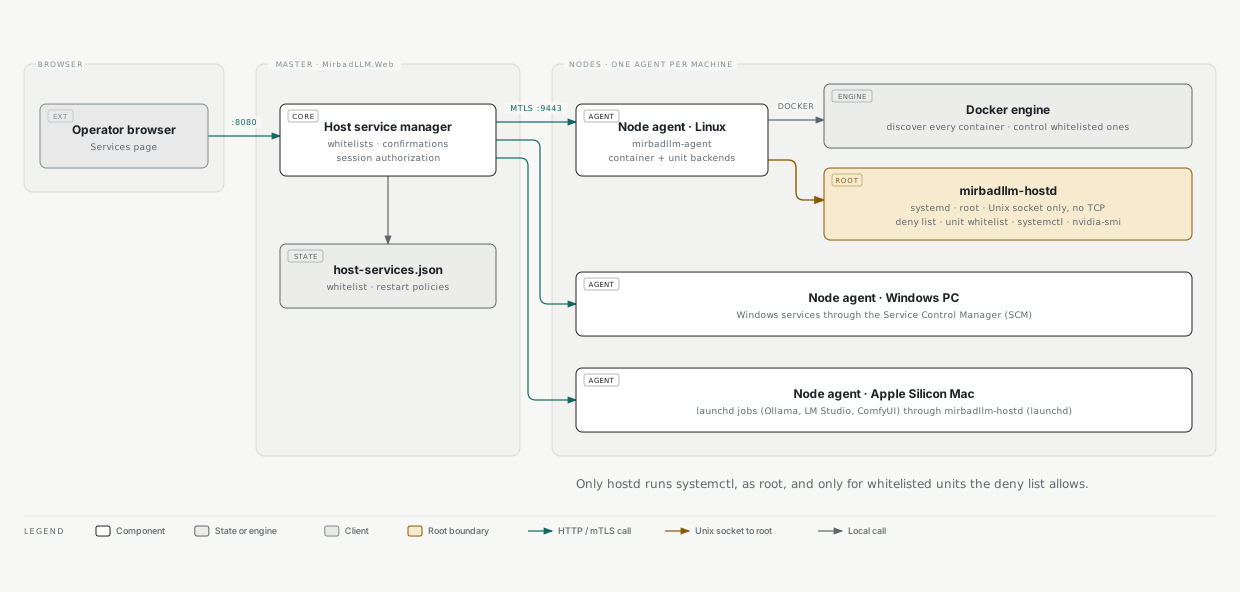
- Contracts (
Core/HostServices.cs):IHostServiceManager(list, discover, run, autostart, whitelist add/update/remove),HostServiceStatus,DiscoveredService(managed + denied flags, deny pattern),HostServiceWhitelistAdd/Update,IAdminReauthenticator,HostServicesOptions(MirbadLLM:HostAgentSocket,MirbadLLM:ManagedContainers= seed only). - Discovery (read-only): the agent merges
systemctl list-units --type=service --all -o jsonandlist-unit-files --type=service -o jsonfor the system manager and for eachdiscoverUsersuser (default: the users of the seed’s user units, i.e. dgxuser), skips templates without an instance (foo@.service), aliases, masked, transient and not-found units, then reads everything else in batchedsystemctl showcalls (state, unit file state,MemoryCurrent, cgroup → GPU memory, description). Units that are loaded but have no unit file are dropped. The node agent adds every Docker container (GET /containers/json?all=true, memory from one-shot stats) exceptmirbadllm, containers labelledmirbadllm.modeland download jobs (mirbadllm.download). The page loads discovery only while Discovered is open (refresh every 30 s) and sorts it by RAM + GPU, largest first. - Security model (in order, each layer enforced where it runs, never only in the UI):
- Socket: only root and the
dockergroup can reach the agent (dirroot:docker 0750, socket0660). The docker group can already control Docker, so the agent does not widen who holds root-equivalent power. - Hard deny list (
HostAgent/DenyList.cs), compiled into the agent:ssh*,sshd*,systemd-*,dbus*,docker*,containerd*,NetworkManager*,networkd*,systemd-resolved*,wpa_supplicant*,polkit*,getty*,serial-getty*,nvidia-persistenced*,nvidia-fabricmanager*,nvidia-*driver*,udev*,cron*,rsyslog*,snapd*,apparmor*,ufw*,chrony*,auditd*,user@*,mirbadllm-hostd*,gdm*,display-manager*,accounts-daemon*,unattended-upgrades*,multipathd*,lvm2*(case-insensitive globs; a bare name is also tested with.service). Nothing the master sends can shrink it; a root-owned, not group/other-writable/etc/mirbadllm/hostd-deny.json({"patterns": [...]}) can only add to it (the agent refuses to start if that file is insecure or malformed). Denied units still appear in discovery, read-only, as “System — not manageable” with the matching pattern. Any action (POST /services/{name}/…) or whitelist-add for a denied unit is 403 (code: denied) and logged;UnitManagerre-checks it below the API, and denied entries found in the whitelist file are dropped (with a warning) when it is loaded. - Whitelist (
HostAgent/WhitelistStore.cs): only whitelisted units are ever started, stopped, restarted or enabled/disabled (unknown name → 404 before anything runs). Stored in$STATE_DIRECTORY/whitelist.json(/var/lib/mirbadllm-hostd, dir 0700, file 0600, written atomically; the agent refuses to start if it is not root-owned, is group/other-writable or is malformed). First start seeds it from/etc/mirbadllm/hostd.json(names, display names, descriptions, protected flags, risks kept); hostd.json entries added later are merged once (their names are remembered inseeded, so a unit removed in the UI is not re-added). Agent API:GET /services(whitelisted status),GET /services?include=all(+discovered,discoveryErrors,denyPatterns),POST /whitelist {unit, scope, user?, displayName?, protected?, confirm}(confirm= the name the unit gets, e.g.smartmontools; the unit must be loaded with a unit file; user units only fordiscoverUsers),PATCH /whitelist/{name} {displayName?, protected?, confirm?}(unprotect needsconfirm=<name>),DELETE /whitelist/{name}, and the read-onlyGET /gpu-processes→[{pid, name, usedMiB, containerId?, unit?, displayName?}](HostAgent/GpuProcesses.cs: nvidia-smi--query-compute-apps=pid,process_name,used_memoryby argv with a 5 s timeout; each PID’s owner from/proc/<pid>/cgroup—docker-<64hex>.scopeor/docker/<64hex>→ container id, else the innermost.serviceunit, with the whitelist’s display name; 503 when nvidia-smi fails). Telemetry uses it (3 s bound; the node agent’sHostdGpuProcessProbe, read by the master’sRemoteTelemetryCollector) for the Overview’s per-model memory history — each model’s container processes summed, named host services kept apart — and falls back to each running model’s budget when the agent is missing, older (404) or failing; every host sample records which source it used. Every change is one journald line with the entry before and after (whitelist add|update|remove service=… before={…} after={…}). Containers: the master keeps the container whitelist in{DataPath}/host-services.json(containers, next torestartPolicies), seeded once fromMirbadLLM:ManagedContainers(or the built-in defaults), and refuses start/stop/restart/autostart for any container not in it; a corrupt file fails closed instead of re-seeding. - Admin session authorization (master,
HostServiceManager+Web/AdminReauthentication.cs): adding a service to the whitelist or unprotecting one uses the signed-in session and typed service name. The server resolves the principal from the HTTP request or Blazor authentication state; request JSON cannot supply it. Password fields in a request are ignored. Login still uses constant-time password comparison and its 5-per-minute rate limit; portal actions do not spend login attempts. With admin login disabled, whitelist changes remain refused. Protected-service confirmations and the agent’s deny list remain enforced. - Protected services: stop/restart/autostart-off need
confirm=<name>(typed in the dialog), checked on the master and again in hostd (403code: confirm).
- Socket: only root and the
- Actions:
--no-block(the page polls status); every call has a timeout (15 s queries, 60 s actions, 10 s nvidia-smi). Status comes fromsystemctl show --timestamp=unix; GPU memory is the sum ofnvidia-smicompute processes whose cgroup is the unit’s cgroup or below it. Each action/refusal is one journald line (action service=… unit=… action=… result=ok|failed|refused). - Master (
Orchestration/HostServiceManager.cs): its unit and container backends areRemoteHostUnitBackend/RemoteHostContainerBackend, which call the node agent, and the agent usesNodeRuntime/HostAgentClient.csandDockerServiceClient.cs; whitelist, confirmations and session authorization stay on the master. Units via hostd; containers via Docker (inspect,stats?one-shot=truememory = usage − inactive_file, start/stop/restart, autostart = restart policy viaPOST /containers/{id}/update). Turning autostart off remembers the old policy inhost-services.jsonso turning it on restoresalways; a container that never had one getsunless-stopped. - Hardening (
deploy/hostd/mirbadllm-hostd.service):User=root,Group=docker,UMask=0117,RuntimeDirectory=mirbadllm-hostd(0750, preserved across restarts so the container’s bind mount stays valid, also created at boot by tmpfiles.d),StateDirectory=mirbadllm-hostd(0700),NoNewPrivileges,ProtectSystem=strict,ProtectHome=read-only,PrivateTmp,RestrictAddressFamilies=AF_UNIX AF_NETLINK AF_INET AF_INET6(the inet families only formount.cifs/mount.nfsin the backup-share test; nothing listens on them),ReadWritePaths=/etc/systemd/system -/etc/mirbadllm-hostd(the backup mount unit and its credentials), kernel/cgroup/clock protections,MemoryMax=256M. enable/disable still work because the managers (PID 1, the user manager) write the unit links, not the agent. - Other platforms: on Windows the agent manages Windows services through the Service Control Manager; on a Mac,
launchd jobs go through
mirbadllm-hostdrunning as the LaunchDaemoncom.mirbadllm.hostd(deploy/agent/macos). - Install (
deploy/hostd/install-hostd.sh): keeps an existing/etc/mirbadllm/hostd.jsonas the seed, installs the unit withStateDirectory, tightens an existinghostd-deny.jsonto root/go-w, restarts the agent (which writes the whitelist on first start) and prints the whitelist’s owner, mode and entries.
Restarts, benchmarks and tuning (Orchestration/Benchmarking/)
Section titled “Restarts, benchmarks and tuning (Orchestration/Benchmarking/)”- Launch config + pending restart. Every vLLM setting is a launch argument. Model containers carry
mirbadllm.config-hash(16 hex of SHA-256 over image + the canonical args,VllmArgsParser.Canonicalize: parsed, normalized and rebuilt in the builder’s order, keeping the budget-derived utilization text) andmirbadllm.budget-gib. A builder output is its own canonical form, so an unchanged definition keeps its hash.ModelStatus.RestartPendingis true for a Starting/Ready container whose hash differs from the saved definition’s; when the label differs, the hash is recomputed from the container’sCmd(cached per container) so a container launched with a raw override in ExtraArgs matches the normalized definition vLLM effectively ran; no label ormirbadllm.tuning=1→ not pending.VllmArgsParserreads a container’sCmdback into a definition so the Apply dialog can list “old → new” even for unlabelled containers. OnlyAutoStartapplies without restart. - Restart:
IModelRuntime.RestartAsync/POST /api/models/{id}/restart?force== stop + remove + create with the saved definition; admission counts the running container’s budget as released (available + own − reserve).IModelLauncher.LaunchAsyncdoes the same with any definition (tuning). - Jobs (
ModelJobService, one at a time per node;JobConflictException→ 409): on-demand benchmark (Ready model, current settings, no restart) and tuning. While a job runs the router is in maintenance mode (IMaintenanceMode,{DataPath}/maintenance.json, cleared on boot): every/v1/*call gets 503code=maintenancewithRetry-Afterfrom the job’s estimate, before the API-key check; the chat page’sIChatClientthrows the same message;/healthz,/metrics,/api/*and the UI keep working. A job first drains (Ready models report 0 running/waiting on fresh samples, 120 s timeout → “noisy: in-flight requests at start”), then samplesnvidia-smifor 5 s (> 10 % → “noisy: GPU busy with work outside mirbadllm”). - Suite (
BenchmarkSuite): streaming chat, fixed prompts, max_tokens = min_tokens = 256, temperature 0, thinking off; warm-up; N = 1/4/8/16 × 3 runs, per-metric median; per-request tok/s = tokens ÷ (total − TTFT), aggregate = tokens ÷ wall, TTFT p50/p95 (nearest rank); prefill of a min(MaxModelLen, 65,536)-token prompt with a unique prefix, then the same prompt again (prefix-cache hit); tool call (schema-without-properties case) and 8 objective questions scored by regex. Other Ready models’num_requests_running(fromIMetricsHistory) during each run → noisy flag. Results:{DataPath}/benchmarks/{modelId}/{yyyyMMddTHHmmssZ}.jsonwith the settings read back from the container and its config hash. API:POST /api/models/{id}/benchmark,GET /api/models/{id}/benchmarks,GET|DELETE /api/benchmark. - Workload presets (schema v2;
WorkloadProfiles,WorkloadScorer): Interactive chat, Agents & tools, Throughput / batch, Long documents, Embeddings. A preset picks the workloads, the score components and the guards. Workloads: an untimed warm-up; short chat of 256 and 1,024 output tokens over code / tool-style / prose prompt sets with a distinct suffix per request, at N = 1, 16 and the configuration’s max num seqs (≤ 64), failed requests counted per level instead of failing the run; tool calls (every repetition, 3 cases) whose arguments must validate against the tool’s JSON schema (JsonSchemaValidator: type, required, enum, items, closed objects); cold 16K/64K prompts (only when they fit max model len), an untimed warm-up and then a fresh random 24-word sequence BEFORE the reusable content each repetition; a shared-prefix workload (a per-run ~8K-token system prompt with different questions, primed once untimed) with the delta of the model’s ownvllm:prefix_cache_hitscounter over the timed questions — “repeated prompt (no cache reuse observed)” when it is 0, “(cache metrics unavailable)” when /metrics can’t be read; the 8 objective questions. Score = weighted geometric mean of candidate ÷ baseline ratios (latencies inverted), weights renormalized over the components measured on both sides: Interactive N1 .5 / N16 .2 / 16K TTFT .3; Agents N1 .25 / N16 .3 / 16K .15 / shared-prefix TTFT .3; Throughput N16 .4 / max-seqs aggregate .6; Long documents N1 .3 / 16K .35 / 64K .35; Embeddings input tok/s N1 .4 / N16 .6. Guards (SloGuards, per preset, overridable throughModelJobOptions.Guards): short TTFT p95 ≤ 1 s at N=1 and ≤ 3 s at N=16, long-prompt TTFT ≤ baseline +25 %, error rate 0, objective answers ≥ baseline (generation), tool validity 100 % (Agents), embeddings: valid vectors, unchanged normalization, latency p95@16 ≤ 2× (Throughput has no latency guards). A non-finite or non-positive active measurement rejects. Results carrySchemaVersion(absent = 1, the classic suite),PresetandRepetitions; v1 benchmarks and tuning runs load and render too.POST /api/models/{id}/benchmark?preset=…runs a preset (no preset = classic suite); the Benchmark page has a preset picker (plus “Classic suite”). - Embeddings suite (pooling models:
--runner pooling,--convert embed,--task embedor theembeddingtag;PoolingDetection): warm-up, then N = 1, 16 and the configuration’s max num seqs (≤ 64) × 3 runs of/v1/embeddingsrequests, each a batch of 4 distinct inputs of mixed lengths (unique per run, so no cache hits); input tok/s (usage.prompt_tokens ÷ wall), req/s, latency p50/p95; shape check (one vector per input, one dimension, finite, non-zero; unit length reported). Rerankers (--convert classify,--task score,rerankertag) are refused for benchmarks and tuning. - Workload-preset search (
SearchPlanner,TuningGates,TuningDescriptions,RuntimeLogParser,TuningEstimator; plan sections B + D). Gates, computed without measuring: MTP only with MTP layers (mtp_num_hidden_layers> 0) and an MTP architecture the image registers (MirbadLLM:MtpArchitectures, matched as{family}MTPagainst the architecture’s base name; when the list is empty the image is unknown and only a saved MTP config counts as proof, else MTP is skipped with the reason); draft-model depths {saved, 3, 7, 11} only with a configured draft model, capped by the drafter’s trained block size from itsconfig.json(unknown → saved depth and off only); Mamba hybrids (hybrid_override_pattern,layers_block_type, mamba/ssm keys, Mamba-family architectures) pair prefix caching on with--mamba-cache-mode alignand off withnone; KV auto gated by memory (FP8 always eligible); dense models over 20 B parameters (estimated from weights and format) also try max num seqs 1 and 2; max batched tokens always includes the saved value and drops values below max model len when chunked prefill is disabled. Phases: (1) KV {fp8, auto} × prefix {on, off} — both prefix configurations always; (2) max num seqs {4, 8, 16, 32, 64}, then max batched tokens {2048 … 32768}; (3) speculative {off, saved, MTP 1/2/3/5 or drafter depths} with FULL_AND_PIECEWISE graphs, then PIECEWISE follow-ups only for a full-graph candidate that failed and for the two best depths (when CUDA graph mode is selected), then async {on, off}; refinement: neighbours of the winning max num seqs and speculative depth with everything else fixed, then prefix on/off with the winning decode settings. Coordinate descent with fingerprint de-dup on the effective configuration, then the confirmation stage. Quick = {max num seqs, speculative}; Full = every dimension (TuningSearchin the API body, or explicitsteps). Pooling models keep the phase-A plan. Each step and candidate carries a goal + tradeoff fromTuningDescriptions(plan preview, live progressJobSnapshot.CandidateDescription, result rows); each result recordsEffectiveConfig(one line of the normalized settings) andRuntimeNotes— the container log parsed for the resolvedcudagraph_mode,SpeculativeConfig(…),async_schedulingand notices such as “max_num_scheduled_tokens is set to …”, compared with the request (“as requested” when nothing differs) — andBenchmarkSeconds. ETA = candidates × (start + benchmark) − a reused start + confirmations × (start + benchmark × 5/3), from the median measured starts of recent runs and benchmark times of the last run with this preset (else the last benchmark with it, else defaults), re-projected live from the run’s own pace. A baseline that breaks an absolute guard (short TTFT p95 > 1 s / 3 s, error rate) makes that guard relative for the run (“no worse than the baseline”), noted on the run. - Tuning (
TuningPlanner,TuningScorer): coordinate descent in a fixed order on top of the best so far — speculative off / MTP × 1-3 (only withmtp_num_hidden_layers> 0; the graph mode is left alone), max num seqs 8/16/32,--max-num-batched-tokens2048/8192/16384 (ModelDefinition.MaxNumBatchedTokens), KV fp8/auto (only when the budget admits one full-length request at auto). Never MaxModelLen or the budget; duplicates skipped. The baseline is the normalized saved definition, so no raw flag can override a candidate. Pooling models only vary max num seqs 4–64 and max batched tokens 2048–32768 and are scored on input tok/s (same goal shapes) with latency p95@16 ≤ 2× baseline, valid vectors and unchanged normalization. Candidates run asmirbadllm.tuning=1containers (registry untouched), wait for Ready (Failed → recorded with the FailureReport cause), then the suite. Bounded recovery: job cancel always propagates; a candidate’s launch error, readiness failure or benchmark failure fails that candidate, then its container is removed and verified gone within 120 s (CleanupTimeout); a start conflict with another model waits up toStartupTimeoutfor it, retries once, else fails the candidate (not the run); when the cleanup itself fails (Docker unreachable, container stuck) the run stops (TuningInfrastructureException), records the candidate, and restores. The restore waits (bounded) for Ready and notes when the model did not come back. Workload presets search with 3 repetitions per candidate, then re-measure the top two accepted candidates and the baseline with 5 repetitions, each from a fresh start, in randomized order (stepConfirmation); a candidate wins only when it beats the re-measured baseline by ≥ 5 % with non-overlapping per-repetition score ranges (ScoreMin/ScoreMax), else the baseline’s re-measurement is the winner (saved settings kept). Runs areSchemaVersion2. An embedding model is always tuned on Embeddings, a generation model never; the classic goals (Balanced, Many agents, Single user) keep the classic suite and scorer without confirmation, for stored runs and API clients (API default stays Balanced; the UI offers the presets). Apply writes the normalized definition: the candidate’s effective owned settings onto the saved one with no owned flag left in ExtraArgs. Guardrails: valid tool call and objective score ≥ baseline. Goals: Single user = N=1 tok/s; Many agents = N=16 aggregate with TTFT p95@16 ≤ 2× baseline; Balanced = √(N1 gain × N16 gain) with the same guard. The saved settings are restored at the end, on cancel and on failure (and at boot for a leftover tuning container); the winner is only applied by the user (Apply best → save → restart dialog). Results:{DataPath}/tuning/{modelId}/{timestamp}.json. API:POST /api/models/{id}/tune({goal, steps}),GET /api/models/{id}/tuning,GET|DELETE /api/tuning.
Model tags and backup & restore
Section titled “Model tags and backup & restore”- Tags (
Core/ModelTags.cs):ModelDefinition.Tags, lowercase slugs[a-z0-9-], 1–24 characters, at most 12, normalized and de-duplicated by the registry (ArgumentException→ 400 otherwise). Built-in catalog with labels and descriptions;ModelTags.Suggest(definition, architecture, hasVisionConfig)is a pure function over the parsers,ExtraArgs, names andconfig.json(ModelFolderInspection.HasVisionConfig). Filter rule: ALL selected tags (ModelTags.HasAll), in the UI (Ui/TagFilter.razor,?tags=a,b) and inGET /api/models?tag=a&tag=b. - Sources (
ModelDefinition.Sources,ModelSource(RepoId, Folder, Revision, AllowPatterns)): the source whose folder equalsModelPathis the primary checkpoint, the others are extra folders. Validated by the registry (repoowner/name, one plain folder name, no duplicates). Tags and sources are not inVllmArgsBuilder’s output, soModelConfigHashandSettingChanges.RestartNeededignore them. - Backups (
Orchestration/Recovery):BackupServicebuilds aBackupDocument(models,HostServicesStore.ExportAsync, and — with a passphrase —BackupCrypto’s AES-256-GCM / PBKDF2-SHA256 (600,000) encryptedBackupSecretswith the API key records). The master writesschemaVersion2 (MultiNodeSchemaVersion):master(instance id, epoch),nodes(non-secret records), per-node host services and, with a passphrase andMirbadLLM:Backup:IncludeCa(default true), the CA in the encrypted section; the secrets are bound to the document version.Parsealso reads version 1 (a single machine’s backup) and refuses other versions, bad JSON and weakened KDF parameters;DecryptSecretsthrowsBackupPassphraseExceptionon a wrong passphrase or tampering.BackupScheduler(hosted) writes one per day toBackupDirectory(MirbadLLM:Backup:Directory, atomic temp + move, prune toKeep, never creates the directory, records failures instead of throwing).BackupDownloadTokens: one-time, two-minute tokens forGET /api/backup/download/{token};GET /api/backup/files/{name}serves only baremirbadllm-backup-<host>-<stamp>.jsonnames inside the directory. - Restore:
RestorePlanner.PreviewAsync(read-only: new/changed/identical with the changed fields, folders on disk viaICheckpointFolders, download sizes viaIHuggingFaceRepoInspector, manual models, new API keys);RestoreJobService(singleton, one job, in memory): upsert →IApiKeyStore.ImportAsync(merge by id/hash) →HostServicesStore.ImportAsync→ per model, sequentialIHuggingFaceDownloaderdownloads of missing folders → auto-start once all folders are present, retryingModelStartConflictExceptionand reportingModelMemoryAdmissionException(model left stopped). Cancel stops the download in flight. A version-1 backup’s models are placed on the bootstrap node, a version-2 backup keeps its placements, downloads run through the model’s node agent and auto-starts run sequentially per node (PerNodeStartLanes). A normal restore never imports the backup’s nodes, master identity or CA; fleet recovery in recovery mode does (docs/multinode/operations-p2.md).
Backup destination (NAS share)
Section titled “Backup destination (NAS share)”- Agent (
HostAgent/BackupMount*.cs):GET/PUT/DELETE /backup-mount,POST /backup-mount/test. The target is fixed (/srv/mirbadllm/backups, unitsrv-mirbadllm-backups.mount); requests only describe the share.BackupMountValidator(pure) allows a small character set per field (no,=quotes newlines%..), the password only printable characters;BackupMountRendering(pure) renders the source, the options, the unit (first line = managed marker) and the cifs credentials file.BackupMountManager: probe = mount into a fresh directory in the agent’s private/tmp(mount -n -t … -o … -- source dir),IBackupMountHost.ProbeWritewrites/reads/deletes a file on a dedicated thread withsetfsuid/setfsgid(1654)(so root’s file capabilities don’t mask a permission problem),umount(lazy as a fallback). Apply = validate → refuse a foreign unit/automount or a foreign mount at the target (409) → probe (422 on failure, nothing written) → write credentials (0600) + unit (0644) →daemon-reload,enable,restart→ on failure restore the previous files, reload and restart the old unit → write the non-secret state. Delete =disable --now(422 and nothing removed if busy) → remove unit, credentials, state → reload,reset-failed→statthe local directory and warn if it is not 1654:1654. Status reads/proc/self/mountinfo(the service namespace is a slave of the host’s, so later host mounts show up) and the free space with a 3 s cap. File system and processes are behindIBackupMountHost/IProcessRunnerfor tests. - Master (
Orchestration/Recovery/BackupDestination.cs):IBackupDestinationManageroverIHostAgentBackupMountClient(RemoteBackupMountClient, through the agent on the master’s machine to its hostd). Apply and disconnect authorize the signed-in portal session (IAdminReauthenticator) before anything reaches the agent; a test needs none. The share password goes to hostd and, after a successful apply, is kept Data-Protection-encrypted on the master (BackupDestinationSecretStore,backup-destination.json) only so passphrase backups can carry it in their encrypted section; it is never shown or logged.BackupDirectory.CurrentMount()reads the container’s own mountinfo for/backups;CheckBeforeBackupAsyncmakesBackupScheduler.RunNowAsyncskip (and report) a run when a share is configured (or was, if the agent stops answering) but/backupsis not a network file system.BackupServicerecordsBackupDocument.BackupDestination(no secret; an optional field, added without a schema version change). - Compose: the backups bind mount uses
propagation: rslaveso a share mounted later on the host appears in the running container.